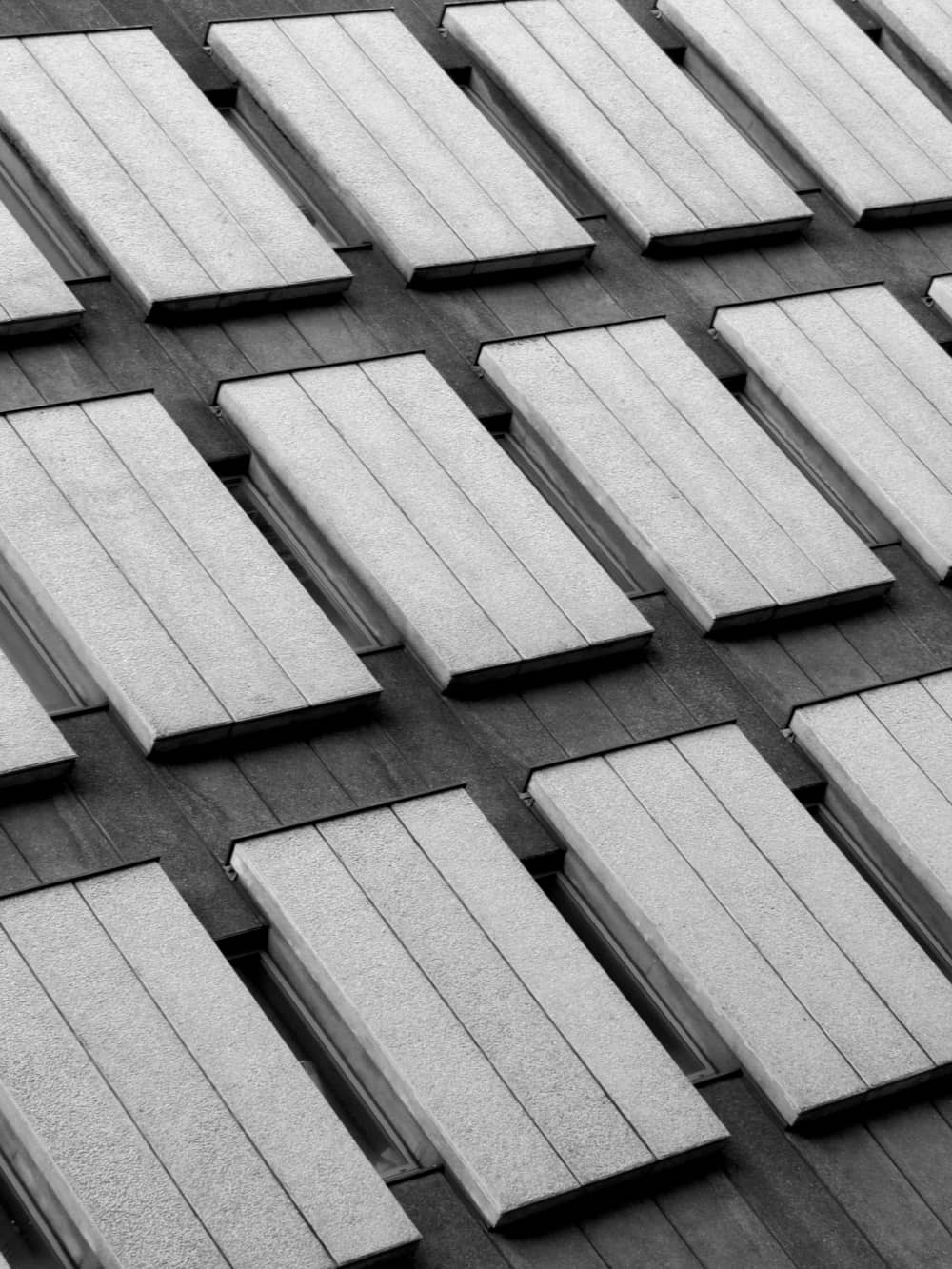
An oblique view of pale concrete facade panels with deep, repeating shadows.

Architecture, in passing

Meridian Notes

A closer look at the buildings
we usually walk past.

Read the journal
Facade study / Concrete and shadowPhotograph by Scott Macpherson

Three ways of looking

A surface, an edge, a change of light. Notes on the small things that give a building its character.

Material study

Concrete

The rhythm of a facade

Repetition is rarely as uniform as it first appears.

In the photograph above, pale panels repeat across a darker surface. From a distance, the eye gathers them into one pattern. Look again and the gaps become just as important as the panels: each narrow shadow gives the neighboring edge a different weight.

An oblique view makes this rhythm especially clear. Horizontal and vertical lines become diagonals, and a flat elevation begins to read as a field of shallow relief. The surface is not changing, but the angle changes which parts of it we notice.

It is tempting to explain every mark as weathering or every joint as a clue to construction. A photograph cannot settle those questions on its own. It can, however, hold an observation still: light on a face, darkness beneath an edge, and a pattern that becomes less regular the longer we look.

Street notes

Thresholds

Where a building meets the street

The most revealing part of a building may be at walking height.

A facade is often photographed from across the road, with the whole building comfortably inside the frame. At the doorway, that tidy picture breaks into smaller decisions. Paving meets a sill. A handrail ends. A canopy changes the quality of the light before the door is reached.

These transitions are worth a slower look. A recessed entrance makes a little room between pavement and interior. A flush doorway offers a different relationship to the street. Neither detail tells the entire story of how a place is used, but each gives the eye a useful starting point.

One good observation is more valuable than a hurried inventory. Notice where the material changes and how that change is resolved. Then step back: the small detail often explains something about the larger composition that was difficult to see from a distance.

Light study

Openings

A window is also a shadow

An opening has depth, even when a drawing gives it only an outline.

On an overcast day, a window can look like a dark rectangle laid on a wall. When sunlight reaches the same opening at an angle, the reveal becomes visible: a short return of material that gives the wall thickness and the glass a place within it.

The shadow may be sharp at one edge and soft at another. Reflected light from the opposite wall can brighten a surface that never receives direct sun. A single photograph records only one of these arrangements, not a permanent property of the building.

When comparing two views, keep the framing similar and notice what has moved. A shadow that changes while the surrounding lines remain fixed is a quiet record of time. The architecture provides the frame; daylight keeps revising the picture.

Looking is a practice.
There is always another detail.

About the journal